Showing posts with label Information. Show all posts

Friday, March 2, 2012

NOKIA 808 PureView - Specifications


NOKIA brought us another generation of camera phones as they bring the NOKIA 808 PureView. The main feature of this gorgeous phone is that it has a 41 MP (38MP effective) camera which can optimize a lot in taking photos.

Also known as NOKIA 808 PureView RM-807 the specifications:


GENERAL:
-2G Network: GSM 850 / 900 / 1800 / 1900
-3G Network: HSDPA 850 / 900 / 1700 / 1900 / 2100
-Announced: 2012, February
-Status:          Coming soon. Exp. release 2012, May

BODY:
-Dimensions: 123.9 x 60.2 x 13.9 mm, 95.5 cc
-Weight:      169 g

DISPLAY:
-Type :               AMOLED capacitive touchscreen, 16M colors
-Size:          360 x 640 pixels, 4.0 inches (~184 ppi pixel density)
-Multitouch: Yes
-Protection :       Corning Gorilla Glass
                        Nokia ClearBlack display

SOUND:
-Alert types: Vibration; MP3, WAV ringtones
-Loudspeaker: Yes
-3.5mm jack: Yes

MEMORY:
-Card slot:        microSD, up to 32 GB
-Internal:     16 GB storage, 1 GB ROM, 512 MB RAM

DATA:
-GPRS:     Class 33
-EDGE:       Class 33
-Speed:        HSDPA 14.4 Mbps, HSUPA 5.76 Mbps
-WLAN:       Wi-Fi 802.11 b/g/n, DLNA, UPnP technology
-Bluetooth:     Yes, v3.0 with A2DP
-NFC:         Yes
-USB:          Yes, microUSB v2.0, USB On-the-go support

CAMERA:
-Primary:        41 MP (38 MP effective, 7152 x 5368 pixels), Carl Zeiss optics, autofocus, Xenon flash
-Features:  1/1.2'' sensor size, ND filter, up to 3x loseless digital zoom, geo-tagging, face detection
-Video:        Yes, 1080p@30fps, loseless digital zoom, LED light
-Secondary: Yes, VGA; VGA@30fps video recording

FEATURES:
-OS:           Nokia Belle OS
-CPU :               1.3 GHz ARM 11
-Sensors:        Accelerometer, proximity, compass
-Messaging: SMS (threaded view), MMS, Email, Push Email, IM
-Browser:         HTML5, Adobe Flash Lite
-Radio:          Stereo FM radio with RDS; FM transmitter
-GPS:           Yes, with A-GPS support
-Java:                Yes, MIDP 2.1
-Colors:      Black, White, Red
                 - SNS integration
                       - Active noise cancellation with a dedicated mic
                       - HDMI port
                       - MP3/WMA/WAV/eAAC+ player
                       - MP4/H.264/H.263/WMV player
                       - Voice command/dial
                       - Document viewer
                       - Video/photo editor
                       - Predictive text input
BATTERY:
-Standard battery, Li-Ion 1400 mAh (BV-4D)
-Stand-by: Up to 465 h (2G) / Up to 540 h (3G)
-Talk time: Up to 11 h (2G) / Up to 6 h 50 min (3G)

Though NOKIA 808 PureView won an award for this feature, they warned the users that photos may size over 10MB each.


Wednesday, November 9, 2011

DISCOVERING GOD’S PROMISES


(1Thess. 5:21 – Prove all things; hold fast that which is good.)


1. Keep a good name. Proverbs 22:1 – A good name is rather to be chosen than great riches, and loving favour rather than silver and gold. 2 Chronicles 7:14 – If My people, which are called by My name, shall humble themselves, and pray, and seek My face, and turn from their wicked ways; the will I hear from heaven, and will forgive their sin, and will heal their land.

2. Be alert. Resist the devil. Prov. 22:6 – Train up a child in the way he should go: and when he is old, he will not depart from it. 1 Peter 5:8 (GNB) – Be alert, be on watch! Your enemy, the Devil, roams around like a roaring lion, looking for someone to devour. James 4:7 – Submit yourselves therefore to God. Resist the devil, and he will flee from you.

3. Know God’s plan. Seek His will in all your decisions. Jer. 29:11 (GNB) – I alone know the plans I have for you, plans to bring you prosperity and not disaster, plans to bring about the future you hope for. Rom 12:2 – And be not conformed to this world: but be ye transformed by the renewing of your mind, the ye may PROVE what is that good, and acceptable, and perfect, will of God. 1 John 5:14 – And this is the confidence that we have in Him, that, if we ask any thing according to His will, He heareth us:

4. Do the best you can in everything, but prioritize God.  (Attend all worship services.) Deut. 28:13 – And the LORD shall make thee the HEAD, and not the tail; and thou shalt be above only, and thou shalt not be beneath; if that thou hearken unto the commandments of the LORD thy God, which I command thee this day, to observe and to do them: Matt 6:33 – But seek ye first the kingdom of God, and His righteousness; and all these things shall be added unto you.

5. Keep your body fit and healthy. 1 Cor. 6:19 – What? Know ye not that your body is the temple of the Holy Ghost which is in you, which ye have of God, and ye are not your own? Rom 12:1 – I beseech you therefore, brethren, by the mercies of God, the ye present your bodies a living sacrifice, holy, acceptable to God, which is your reasonable service. Psalms 103:2-3 – Bless the LORD, O my soul, and forget not all his benefits: Who forgiveth ALL thine iniquities; who healeth ALL thy diseases;

6. Take the challenge. Bring all your tithes and offerings. Malachi 3:10-12 – Bring ye ALL the tithes into the storehouse, that there may be meat in the mine house, and PROVE ME now herewith, saith the LORD of hosts, if I will not open you the windows of heaven, and pour you out a blessing, that there shall not be room enough to receive it. And I will rebuke the devourer for your sakes, and he shall not destroy the fruits of your ground; neither shall your vine cast her fruit before the time in the field, saith the LORD of hosts. And all nations shall call you BLESSED: for ye shall be a delightsome land, saith the LORD of hosts.

7. Know God personally, as to a Friend. Read His (letters) Word and talk to Him in prayer. John 5:39 – SEARCH THE SCRIPTURES; for in them ye think ye have eternal life: and they are they which testify of Me. Mark 11:24 – Therefore I say unto you, What things soever ye desire, when ye pray, believe that ye receive them, and ye shall have them. John 15:14 – Ye are My friends, if ye do whatsoever I command you.

8. Keep a family altar. Have a regular family worship. Psalms 55:17 – Evening, and morning, and at noon, will I pray, and cry aloud: and He shall hear my voice. Isaiah 55:6 – SEEK YE THE LORD while He may be found, call ye upon Him while He is near.

9. Prepare to meet thy God. 2 Kings 20:1 – Thus saith the LORD, Set thine house in order; for thou shalt die, and not live. James 5:16 – Confess your faults one to another, and pray one for another, that ye may be healed. The effectual fervent prayer of a righteous man availeth much. Amos 4:12 – Therefore thus will I do unto thee, O Israel: and because I will do this unto thee, prepare to meet they God, O Israel.

10. Heaven is our home. Our ultimate goal is to see Jesus and our loved ones. John 14:1-3 – Let not your heart be troubled; ye believe in God, believe also in Me. In My Father’s house are many mansions: if it were not so, I would have told you. I go to prepare a place for you. And if I go and prepare a place for you, I will come again, and receive you unto Myself; that where I am, there ye may be also. Phil. 3:20 (ESV) – But our CITIZENSHIP is in heaven, and from it we await a Savior, the Lord Jesus Christ.

“Eye hath not seen, nor ear heard, neither have entered into the heart of man, the things which God hath prepared for them that love Him.” – Cor. 2:9.


Friday, September 16, 2011

Nazca Lines – What are they?


The Nazca Lines is an ancient geoglyphs located in southern Peru in Nazca desert. The area stretches more than 80 kilometres (50 mi) between the towns of Nazca and Palpa. Scholars believe that the Nazca Lines were created by the Nazca people itself from their culture during the late 650 AD. The figures are occasionally simple geometric straight lines and some animal like figures such as hummingbirds, spiders,monkeys, fish, sharks, orcas, llamas, and lizardsthat can be seen from above or aerial view. Still from this year they are consider mystery as some other people doesn't believe it was created by the Nazca people. It is still in a hot seat and people are still debating whether they are created by the Nazca people or it involves extraterrestrial beings. Many believe and question the Nazca people if they are really the creator of this unbelievable geometric figures because some says that there are no signs of flight during their Era. To create a beautiful line like that of Nazca Lines with huge and stretching size, you may need an aerial help to check and see how the workings of line will do. But some archeologists can't find any sign of flight yet though there are certain evidences that justifies the Nazca Lines was made by the Nazca people which is the tools they used to engraved such design. Nazca people are indeed smart one that some scholars believe that their are some existence of advance technology in their Era. Some says that it was the extraterrestrial beings who have just mistaken as to be their gods that made the lines. Study shows and some other theories refer Nazca lines are made for rituals, spiritual, ceremonial relics, etc. They believe Nazca Lines are used for some ceremonial activity to thank their Gods and to produce some development like increase in crop production, etc. Still Nazca Lines are indeed on the top header when it comes to mystery files.

Apple juice – What can you do?


Thinking how liquids can turn you into such shape, you might prefer drinking different liquids especially juice. There are many types of juices like fruit juice, vegetable juice, etc. But, in the head of fruit juices, apple juice is one of the most popular among others. Same as the benefits of an apple can give you can also benefits with its juice especially when it is pure and clean juice of an apple. You know the saying “an apple a day keeps the doctor away” is somewhat true because of its benefits to our body.

Unlike the apple itself, apple juice can be more beneficial than the fruit itself. The juice of an apple contains such chemicals which are very healthy and beneficial to our body like the flavonoid. Here are some benefits that apple juice can give to you:


Loss weight. Fruits are very versatile in every diet that is why apple is one factor to reduce your total weight. There is a study that a person who eat three pieces of apple during his/her diet has the chance to lose weight faster than a person who doesn’t eat any other fruit during his/her diet. The juice of an apple burn some cholesterol in less range of time but very beneficial if often include in every diet.


Strengthen bones. The content of the juice of an apple has boron that can strengthen your bones. There are researches that a flavonoid called phloridzin can help decrease the risk of a person to osteoporosis especially for woman who are very prone to this kind of disease.


Prevents asthma. Asthma can be prevented in chance by drinking apple juice. Another research shows that a person with asthma who drank apple often or drank apple every day decreases the chance to suffer wheezing than other person who just eat apple in one day or two. A pregnant woman might also prevent her child in exposing to asthma by drinking juice during her pregnancy days before the birth.


Prevents cancer. Apple juice is one of the best ways to prevent different cancer diseases like liver cancer, colon cancer, breast cancer, lung cancer, etc. The juice of an apple gives a person a high percentage protection to prevent cancer cells emerging in some parts of a person’s body. Scientist believe that it is the flavonoids, which found in an apple juice that gives a person the protection and help fight cancer cells.

Wednesday, September 14, 2011

Photography


Modern cameras have several features that help photographers control their results under widely varying conditions. Learn more about using aperture size and shutter speed to produce better images.


Anatomy of a camera

When you take a photograph, the film in your camera is exposed to light. The quality of your photograph depends on how much light reaches the film and how long the film is exposed to light. Two camera controls aperture size and shutter speed affect the exposure.


Lens aperture

The size of a camera’s aperture regulates how much light reaches the film. As you increase the aperture size, you increase the amount of light that can reach the film. Aperture size also determines a photograph’s depth of field that is how many object at varying distances remaining in focus. Smaller aperture size produces greater depth of field, more objects remain in focus.

Shutter speed

The camera’s shutter speed also controls exposure. A slow shutter speed allows more light to reach the film resulting to uneven effect of light to the photograph which is usually more exposed to light. An average shutter speed controls the light to reach the film resulting to a clear distribution of light to the photograph. Shutter speed also controls the appearance of moving objects in the photograph. Fast moving objects appear blurred in the photograph is taken with a slow shutter speed.
Exposure is determined by the combination of the aperture size and the shutter speed. The two controls act together to produce the final image.

Friday, September 2, 2011

World Music Tour


Bagpipes of Scotland. Bagpipes are the national instrument of Scotland. It is claimed they can be heard miles away. Players, called pipers, blow air into a bag while squeezing it to force air into the sound-making pipes.

Jazz Saxophone. Many famous jazz musicians have played the saxophone, which has a very expressive sound. The saxophone was invented in about 1840. Jazz is a style of music that African Americans created in the early 1900s.

Blues Guitar. The guitar has always been important to the blues, a musical style invented by African American in the 1800s. In the 1940s, blues musicians in cities like Chicago started playing the electric guitar, giving blues a louder, steelier sound.

Veracruz Harp of Mexico. The Veracruz harp is featured in son jarocho, which is lively dance music from the Veracruz region of eastern Mexico. Son jarocho mixes musical styles that came to Mexico from Spain and Africa hundreds of years ago.

Bluegrass Banjo. Bluegrass is country music from the Appalachian Mountains of the southeastern United States. A bluegrass musician may use their fingers to quickly pluck a five-string banjo, making very lively music.

Panpipe of Bolivia. The panpipe is a type of flute usually made of bamboo. It is one of the world’s most ancient instruments. It is an important part of traditional music in the South American country of Bolivia.

Steel Drums of Trinidad and Tobago. Steel drums are the main instrument of calypso, a type of dance music from the Caribbean islands of Trinidad and Tobago. A steel drum is shaped like a bowl and produces different notes depending on where it is struck.

Conga Drums. Conga drums bring a lively beat to many types of music from the Caribbean islands. They are heard sometimes in a fast-paced dance music called merengue, which is from the Dominican Republic.

Hurdy-Gurdy of France. The hurdy-gurdy is a type of fiddle that was invented in Europe on the 1100s. Today, the instrument is still heard in the folk music of France. The hurdy-gurdy is mechanized: A player cranks a wheel to sound the strings and presses keys to change the note.

Accordion of Europe. The accordion is a very popular folk instrument in Europe, where it was invented in the 1800s.  An accordion makes sound through the bellows, a chamber for pumping air. Players push buttons and piano-like keys to produce different notes.

Balalaika of Russia. The balalaika is one of Russia’s most popular instruments for folk songs and dances. It has three strings and comes in six different sizes. It was invented in the 1700s.

Santur of Iran. The santur, an ancestor of the piano, has been an important instrument in Iran for thousands of years. Players use spoon-shaped hammers to strike the santur’s wire strings, which are attached to a sound box.

‘Ud of Egypt. The ‘ud is an ancient instrument of Arabic culture. It is an ancestor of similar stringed instruments, like the lute and guitar. Traditional Egyptian music often features the ‘ud.

Talking Drum of West Africa. Talking drums are played in West Africa, where they have long been used for sending messages across great distances. The two head of the drum are strung together with laces. Squeezing the drum’s laces changes its pitch.

Kora of The Gambia. The kora, a traditional instrument of The Gambia, is similar to a harp. It has 21 strings, which are attached to a long neck. Its body is made from a hollow, dried gourd (hard-skinned fruit).

Mbira of Zimbabwe. The mbira (pronounced em-BEER-a) of Zimbabwe is a type of thumb piano invented in Africa. A player uses thumbs or forefingers to pluck metal strips that are attached to a sound board or box.

Sitar of India. The sitar is a stringed instrument from northern India. It is like a guitar, except its neck is about 3 feet (1 metre) long. It has two layers of strings, which vibrate to create a rippling, wavy sound.

Khaen of Thailand and Laos. The khaen is a type of mouth organ made with long bamboo pipes. To play it, a musician inhales and exhales through an air chamber, never stopping to catch a breath.

Qin of China. The qin (pronounced chin) has been a classical instrument of China for more than 1,000 years. The qin is a type of stringed instrument called a zither. The qin has seven strings attached to a long wooden body.

Taiko of Japan. The tradition of taiko drumming has existed for more than 1,000 years in Japan. In Japanese, taiko means “fat drum.” The drums were traditionally used by warriors in battle and in religious ceremonies.

Bonang of Indonesia. In Indonesia, large groups of musician called gamelans play only percussion instruments (gongs, chimes, xylophones, and drums).

Didjeridu of Australia. The didjeridu is a type of trumpet invented by the Aboriginal people of Australia. It is made from a hollow tree branch. A player vibrates his or her lips on the mouthpiece while inserting vocal – trills, buzzes, barks and grunts – to imitate animal sounds.

Monday, August 29, 2011

We are Cats!


Different cats look, act and meow in different ways depending on their breed.

American Curl. The American Curl is so named because its ears curl backwards.

Oriental. The Oriental can be either longhaired or shorthaired. Both come in many different colors.

Sphynx. The Sphynx is mostly hairless, so it gets cold easily.

Maine Coon. The Main Coon can grow very big, and has a soft, thick coat and a long tail.

Ragdoll. The ragdoll is a brave cat with long, thick fur.

Turkish Angora. The Turkish Angora has long, silky fur. Tufts of fur grow between its toes and on the tips of its ears.

Siamese. Siamese cats are good jumpers and have very loud voices.

Manx. The Manx is a tailless cat native to England’s Isle of Man.

Russian Blue. The Russian blue is an elegant and gentle cat with bright green eyes.

Himalayan. The Himalayan has long hair that is light-colored with dark markings around the face, feet and tail.

Norwegian Forest Cat. The Norwegian forest cat’s long, soft top coat covers a thick undercoat of hair that keeps water out.

Persian. Persians have long, plush coat in a broad range of colors. Blue, black and white are the most common colors.

Abyssinian. The Abyssinian is a loving cat that has fine, soft fur like a wild rabbit.

American Shorthair. The American shorthair came to America with the Pilgrims on the Mayflower.

Devon Rex. The Devon rex has a short, wavy coat that feel like velvet.

Cornish Rex. The Cornish rex has green eyes and its fur feels like velvet.

Exotic Shorthair. The exotic shorthair has big, round eyes and is an easy pet to care for.

Korat. The Korat has big, light green eyes and short silvery-blue fur.

Bombay. The Bombay is a black cat with a sleek and glossy coat.

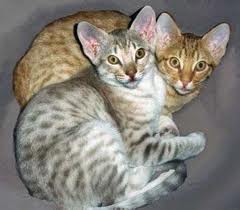
Ocicat. The ocicat can be trained to respond to your commands and will walk on a leash.

British Shorthair. The British shorthair’s fur feels like a plush teddy bear.

Burmese. The Burmese has gold-colored eyes and a muscular body.

Japanese Bobtail. The Japanese bobtail is a stripy cat with a short tail.

Tonkinese. The Tonkinese is a cross between a Siamese and a Burmese cat.

Bengal. The Bengal’s coat is glossy and soft, and is marked by lots of spots.

Singapura. The Singapura is the official mascot of the nation of Singapore.

Cymric. The Cymric is a longhaired tailless cat.

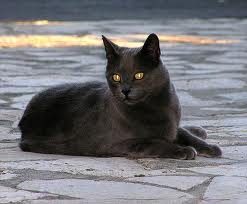
Chartreux. The Chartreux is also known as the blue cat of France and the smiling cat.

Balinese. The Balinese has bright blue eyes and long, silky fur.